Prohealth Resources
BeautyLine4U
“Breast Augmentation”
The preoperative design of the breast augmentation procedure is crucial for the entire surgical process. Design considerations include the placement of implants (Above the muscle, below the muscle, subfascial), incision choices (In the armpit, under the breast fold, around the areola, at the navel), and optional implant types (Teardrop-shaped, saline-filled, gel-filled, autologous fat).
Determining the position of the inframammary fold takes into account the individual's chest morphology and the relationship with the implant size. Prior to surgery, it is essential to carefully consider these factors and establish the correct surgical plan to avoid postoperative issues that may be challenging to correct. With advancements in medical technology, patients have a diverse range of choices and can undergo surgery under improved conditions.
What Are The Aesthetic Standards For The Breast?
Influence by hormonal factors, breasts begin to develop during adolescence and gradually achieve the desired full and elastic form, creating beautiful and resilient breasts. Breasts serve 2 essential functions: firstly, as a symbol of maternity, carrying out the nurturing function for the next generation; secondly, breasts contribute to the continuous allure of femininity for women. When undergoing any breast augmentation surgery, maintaining these 2 functional roles is of primary consideration. The definition of beautiful breasts is, to a certain extent, subjective and challenging to articulate in concise terms. From an objective perspective, considering factors such as breast shape, the line from the neck to the chest and the appearance of the nipples is necessary. Medically speaking, beautiful breasts are characterized by elasticity, presenting a conical shape when viewed from the front, and a smooth and natural curve from the neck to the nipple when observed from the side. When lying flat on the front, the breasts should slightly tilt outward, and when viewed from above, the nipples should project slightly outward for added charm. Additionally, a subtle fullness in the transition from the armpit to the breast contributes to the overall beauty.

1. Breasts That Are Of Moderate Size And Possess Elasticity
The size of the breasts should be harmonious with the individual's body shape, avoiding the pursuit of excessively large or small breasts. It is important for the breasts to be appropriately full and elastic. The ideal standard for breast size varies based on individual body shape and weight, but the width of the shoulders, chest circumference and breast size should be mutually coordinated. In Chinese women, using the above-mentioned circumferences as reference standards, the breasts should be approximately 20- 25cm longer than the waist circumference, and 2- 5cm shorter than the hip circumference, with each breast having a volume of around 200cc. However, in Western cultures, an ideal figure is considered to have a chest circumference equal to the hip circumference, with each breast having a volume of around 300cc.
. . .
2. The Beauty Of Rounded And Full Curves
The ideal beautiful breast is described as forming an equilateral triangle with the center of the clavicle and the connection points of the nipples on both sides. This means that the ratio of the diameters of the nipples, areolas and breasts should be coordinated to create the appearance of beautiful breasts. Even if the breast size is moderate and the shape is charming, it may not look beautiful if the ratio of the areolas or nipples is not in harmony. The ideal breast shape should be full and conical, slightly protruding outward, symmetric on both sides and slightly sagging overall. This is considered the most ideal breast shape in medical aesthetics. To achieve the ideal beautiful breast, having well-developed mammary glands is not enough; the amount of subcutaneous fat needs to be sufficient to fully showcase the beauty of the curves. The distance between the nipples on both sides should exceed 20cm, and the connection line from the armpit to the breast should have a gentle and harmonious contour. Lastly, the diameter of the areolas is approximately 3.5cm, the diameter of the nipples is about 1cm, and the distance between the breast creases and the nipples is approximately 5cm – these are important criteria in breast aesthetics.
. . .
3. Natural Breast Movement
The natural sway of the breasts varies with body movement, presenting different forms depending on body posture, actions, and intensity. For instance, brisk walking or running induces more significant breast movement, while slow walking or remaining still results in comparatively smaller sway. This inherent motion adds a lively and dynamic appearance to the breasts, with subtle variations in the swaying pattern for each individual.
. . .
Medical Anatomy Of The Breast

The breast is an organ present in both males and females, but it serves a more crucial role in the female body. In females, the breasts undergo development during adolescence under the influence of hormones. The mammary gland tissue within the breasts plays a pivotal role in lactation, secreting breast milk postpartum and serving as a vital component in nurturing the next generation. Consequently, the breasts can be regarded as one of the reproductive organs in females.
Breast tissue is divided into mammary glands responsible for the production and secretion of milk and ducts that connect the glands to the nipple. The remaining portions are predominantly composed of adipose tissue and other interwoven tissues. During adolescence, hormonal secretion increases, leading to the gradual development and enlargement of the mammary gland tissue. After menopause, this tissue begins to atrophy.
The entire breast has a semi-spherical shape, featuring a central nipple. The skin around the nipple, which contains more pigmentation is referred to as the areola. The breast is richly innervated, with a dense network of nerves and maintains close connections with other reproductive organs.
The breasts are located above the pectoralis major muscle, typically extending from the 2nd to the 6th rib and bordering the sternum on the inner side. On the outer side, they can reach the midaxillary line. While there may be variations in the morphology and structure of breasts among individuals, their significance and close association with other reproductive organs remain similar.
Breast Augmentation Implants
Choosing the right implant is crucial for the outcome of breast augmentation surgery as it directly influences the size and shape of the breasts. In breast augmentation procedures, the selection of implants is equally important as determining the surgical approach and incision placement. Breast augmentation implants come in various options including different materials, surface textures, shapes and sizes.
Classification of Breast Implant Materials
Cohesive Gel
Highly cohesive silicone gel is a semi-solid, highly cohesive and mobile gel-like implant. Introduced worldwide (except in South Korea and the United States) since 1993, it has undergone clinical trials and proven to be a safe implant. It received FDA approval in 2006 and certification from the Korean Food and Drug Administration in July 2007. Implants certified by organizations like Mentor and Allergan are commonly used. The use of highly cohesive silicone gel provides more options for breast augmentation, enhancing surgical outcomes.
The term "highly cohesive silicone gel" refers to silicone gel specially formulated to maintain its cohesive form even in the event of package rupture, ensuring containment and ease of removal. Breast augmentation surgeries using highly cohesive silicone gel implants involve making incisions through the armpit, areola or inframammary fold, and then inserting the pre-packaged implants. This approach ensures simplicity, safety and improved results in breast augmentation procedures.
Saline-Filled Implant
Saline-filled implants are indeed considered a relatively safe choice. In the event of implant rupture or leakage, the saline solution is naturally absorbed by the body without causing significant harm to health. This makes saline-filled implants a comparatively safe option.
Compared to silicone gel implants, saline-filled implants have a slightly firmer feel. This is because the filling is saline solution rather than the softer silicone gel. During the surgery, saline solution is injected into the implant to achieve the desired breast size and shape.
Due to the liquid nature of the filling, saline-filled implants can be inserted through smaller incisions including incisions made through the navel. This technique is known as transumbilical incision which can help minimize surgical scars to a certain extent.
However, the specific surgical approach and incision choice should be determined based on individual circumstances and the advice of the medical professional. Each patient has unique needs and physical conditions, so when choosing the appropriate implant and surgical method, it's best to consult with a qualified doctor for their opinion and advice.
Silicone Gel Implant
Silicone gel implants have advantages in terms of touch and often result in high postoperative satisfaction. Despite some controversies, there is currently no conclusive evidence indicating inherent harm from silicone gel implants.
However, a potential risk associated with silicone gel implants is that if the implant ruptures, silicone gel may leak into the surrounding tissues. This is considered a drawback of silicone gel implants and may lead to complications or require further intervention.
To ensure patient safety, many countries have prohibited the use of liquid silicone gel implants since 1993. This is aimed at minimizing the risk of implant rupture and reducing potential complications that patients may face.
Overall, choosing the right type of implant is a personal decision that should take into account individual needs, medical advice and available scientific evidence. When deciding on the type of implant to use, it is advisable to consult with a qualified medical professional and thoroughly assess the risks and benefits associated with each option.
Autologous Fat
Due to the absence of foreign materials, autologous fat breast augmentation avoids issues related to rejection reactions. Additionally, the small incisions made during autologous fat breast augmentation result in relatively minimal scarring. Moreover, the procedure allows for body contouring in other areas by utilizing excess fat, achieving an overall shaping effect.
Compared to breast augmentation with implants, the recovery process for autologous fat breast augmentation is generally simpler, and the recovery time is shorter. Unlike implants, once the transplanted autologous fat fully survives, there are no issues with the feel of the breasts.
However, it's important to note that a significant drawback of autologous fat breast augmentation is the partial absorption of the transferred fat. The remaining volume of fat may not fully meet the desired breast size or fullness. The success of autologous fat breast augmentation also depends on individual factors such as the amount of available fat and the absorption rate. Therefore, when considering breast augmentation, doctors will assess the patient's body characteristics and fat supply to determine whether autologous fat breast augmentation is suitable.
Classification Of Breast Implant Shapes


Axillary Incision
Periareolar Incision
Inframammary Incision
Incision Near The Navel
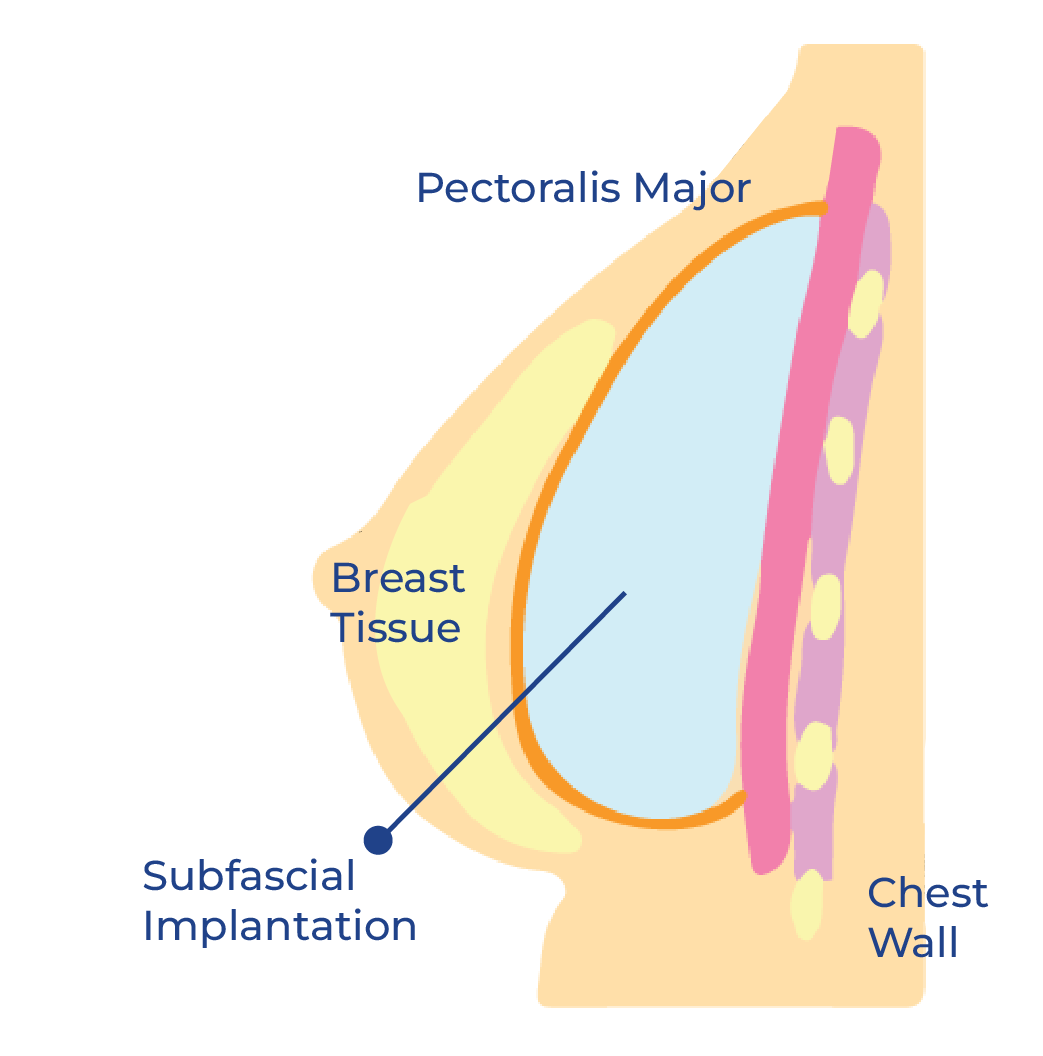
Various Surgical Methods Based on Different Breast Implant Placement Locations

Implantation on the pectoralis major muscle
One of the most commonly used surgical methods lately is the placement of implants just beneath the breast tissue. However, the choice of this surgical method depends on the individual circumstances of the patient. This method is suitable for those with severe breast sagging, ample breast tissue (skin, subcutaneous fat, and glandular tissue), and minimal impact from the contraction of the pectoral muscles.
The advantage of this method is its suitability for patients with sufficient natural breast tissue and significant breast sagging. Since the implants do not move with muscle contraction, they can maintain the expected shape, and there is less postoperative discomfort.
However, a drawback of this method is that when there is insufficient breast tissue, the presence of the implants may be felt, and there could be an increased risk of breast contracture (hardening of the breast). It's important to note that each individual's situation and surgical outcomes may vary. When considering breast augmentation surgery, consult with a professional surgeon for personalized advice and detailed information.

Implantation under the pectoralis major muscle
In this method, the implants are placed beneath the chest muscle behind the breast tissue. This approach has several advantages: Firstly, as the muscles cover the implants, the depth of the implants results in a more natural breast shape post-surgery. People generally feel little difference in touch between the breast with implants and the natural breast. Secondly, the muscle coverage of the chest muscle helps reduce the risk of implant encapsulation, a complication where the tissues around the implant contract and form a fibrous capsule. Additionally, choosing this implantation method allows for continued pregnancy, breastfeeding and does not interfere with breast cancer examinations. However, there are some considerations and drawbacks to the submuscular implantation method. Firstly, when the breast tissue is insufficient, the presence of the implants may be felt, and there could be an increased risk of breast contraction (hardening). It's important to note that each individual's situation and surgical results may vary. When considering breast augmentation surgery, it's advisable to consult with a professional doctor for personalized advice and detailed information.
After The Surgery
Before/ After Surgery Pitures